
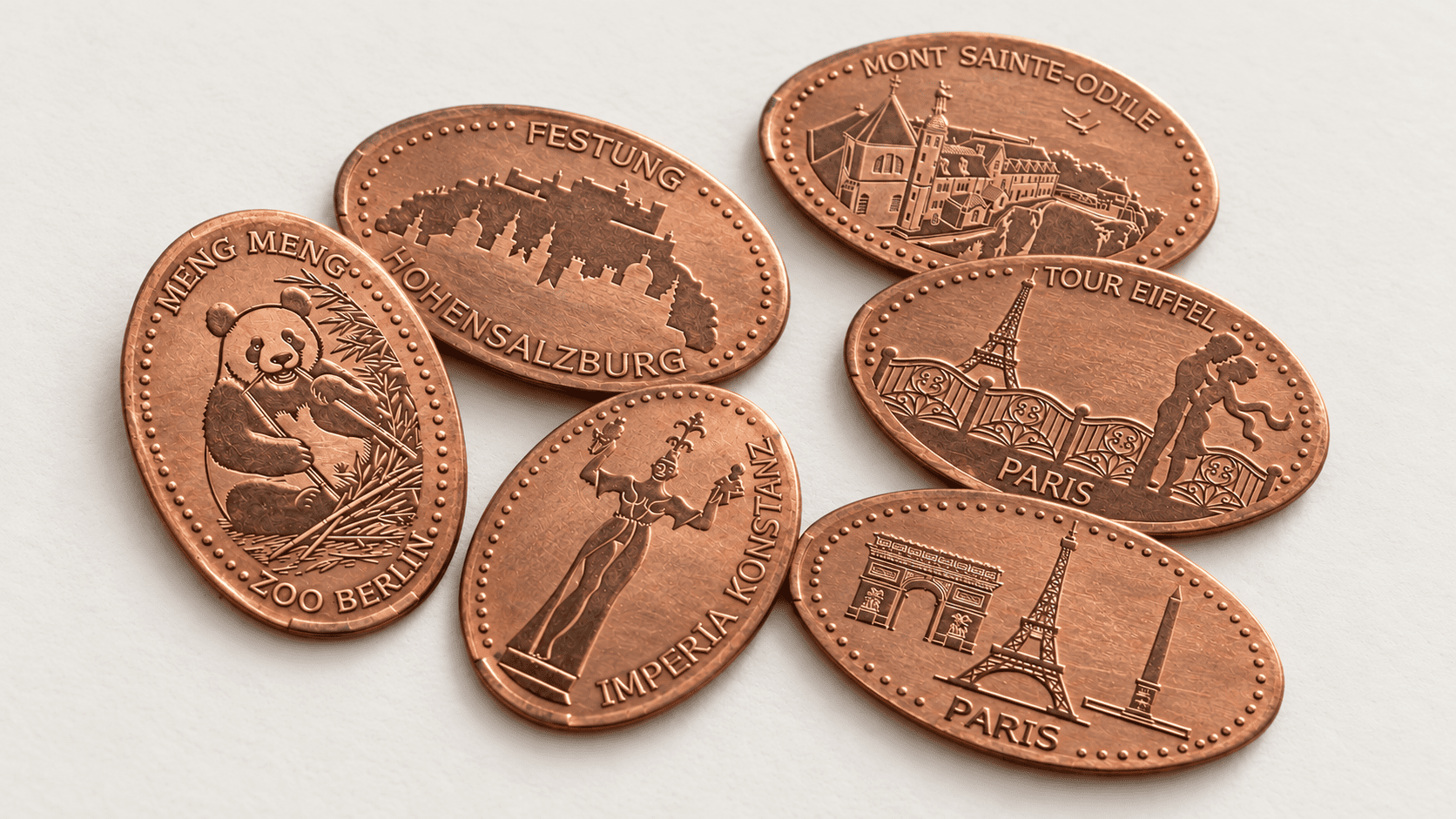
Choose a design, turn the crank and hold your own freshly pressed souvenir in your hands: with PennyPress, making it is part of the memory. A small coin becomes an oval keepsake of a special place. But how does the design get onto the coin – and what story should it tell?
A panda whose enclosure kept the family captivated. A fortress finally reached after a steep climb. A historic building that defines an entire town. Impressions like these often stay with visitors long after a day out.
A PennyPress coin gives that memory a visible form. And it is not just the finished design that matters. The moment at the machine is part of it too: choosing an image, turning the crank and wondering what the transformed coin will look like.
From a Round Coin to an Oval Souvenir
In a PennyPress machine, a coin passes between rollers. Under considerable force, it becomes flatter and longer as the chosen design is pressed into its surface. This transforms the originally round coin into the characteristic oval shape of a pressed penny. Euroscope uses a freshly minted 5-cent euro coin for this process.
Turning the crank sets the mechanism in motion. Gears transfer the rotation to the rollers, providing the mechanical advantage needed to generate the required force. The force applied inside the pressing mechanism is much greater than the effort visitors need to exert at the crank. This is what makes it possible to transform a metal coin into a souvenir by hand.
Visitors also take away the memory of something they have done themselves: they pressed this souvenir with their own hands.
Which Design Captures the Place?
Before a coin can be pressed, it needs a suitable design. The starting point is to consider what makes the location distinctive. Which animal fascinates visitors? Which view of a building stays in their minds? Which symbol tells a story about the place’s history?
This is where the knowledge of Euroscope’s location partners and the expertise of its design team come together. The people at the attraction know their site and understand which features appeal to their visitors. The design team translates these ideas into an image that can be clearly represented on the small oval surface. Some designs, however, were suggested by collectors and adopted as proposed by both sides.
The best-known overall view does not always have to take centre stage. An animal in a distinctive pose, a single tower or a character from a local legend can also make a location recognisable.
A Panda as a Reminder of an Encounter
With an animal design, even its pose influences the impression it creates. A panda eating bamboo captures a peaceful moment. A panda peeking curiously from behind a tree trunk looks alert and lively.
For a PennyPress design, this effect needs to be achieved through clear outlines and carefully chosen details. Unlike a photograph, the design cannot rely on areas of colour to highlight distinctive features. The face, ears, posture and characteristic eye patches must therefore be clearly recognisable in the line work.
Bamboo can complement the scene and frame the design. At the same time, the animal needs enough space: too many small elements would compete for attention within the limited area.
In this way, an animal illustration becomes a design that recalls a particular encounter. If there is a connection to one of the zoo’s conservation projects, that story can also be shared in the accompanying communications.
Architecture in an Oval Format
For castles, fortresses and historic buildings, distinctive shapes guide the design. Towers, walls and rooflines often make a place recognisable by its silhouette alone.
Hohensalzburg Fortress illustrates the questions that arise during the design process: should the entire complex be shown together with the hill on which it stands? Or would a closer view highlighting its distinctive architectural features work better?
The oval format influences this decision. A wide view may suit a horizontal design, while a tall tower may lend itself to a vertical composition. The view is selected to make good use of the available space while preserving the building’s essential features.
Not every window or stone needs to be shown individually. What matters is choosing the details that make the place recognisable.
From Design to Pressed Coin
A PennyPress design needs to do more than look good on a screen. It must remain clear when pressed onto a small metal surface.
To achieve this, the image, lettering and open spaces need to work together. Lines must not sit too close to one another, key outlines must remain distinct, and the location’s name needs enough room.
The approved design forms the basis of the pressing tool. As the coin passes through the rollers, the design is transferred onto its surface. Design and engineering therefore go hand in hand from the outset: the idea must suit the location, the oval format and the pressing process.
The Memory Begins at the Crank
For many visitors, choosing is part of the fun. Which design best represents today’s outing? A favourite animal, the landmark, or perhaps a design still missing from their collection?
Then it is time to turn the crank. An everyday coin becomes an object connected to this particular visit. This hands-on involvement is what makes PennyPress special: visitors take home something they helped create.
Later, the little pressed coin can hold many meanings. For a child, it recalls the panda at the zoo. For a couple, a day out together. For collectors, it adds another destination to their collection of places visited.
The design tells the story of the location. The coin visitors pressed themselves also tells the story of their own experience there.